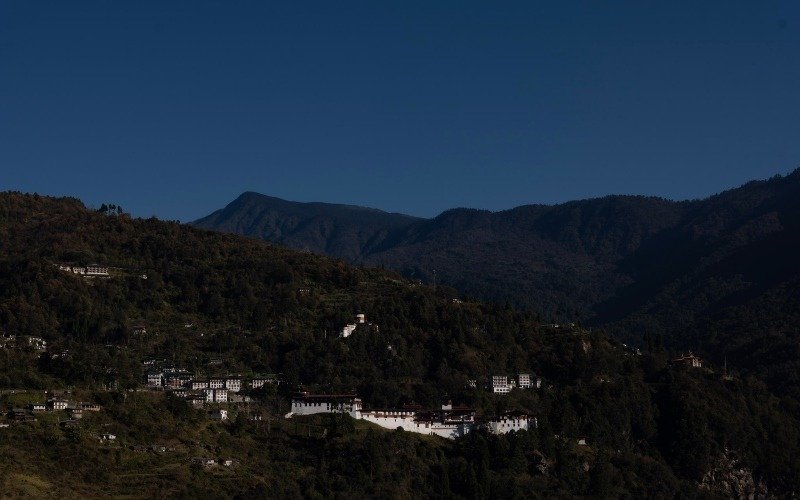
Nestled in the mountainous heart of Bhutan, Trongsa has long stood as a symbol of political authority, royal heritage, and artistic identity. Known as the ancestral seat of the Wangchuck dynasty, the central Bhutanese quarter continues to hold immense literal significance through its iconic Trongsa Dzong and the Royal Heritage Museum at Ta Dzong.
Frequently referred to as the “new village” in Dzongkha, Trongsa historically served as a strategic gateway linking eastern and western Bhutan. The assessing Trongsa Dzong, erected in the 17th century, formerly controlled the country’s pivotal trade routes and became deeply tied to the elaboration of Bhutan’s monarchy.
The significance of the region dates back to 1647, when Zhabdrung Ngawang Namgyal established the institution of the Trongsa Penlop—a position historically regarded as the pathway to Bhutan’s throne.
Continuing this royal tradition, His Majesty King Jigme Khesar Namgyel Wangchuck was formally installed as the 16th Trongsa Penlop at Trongsa Dzong on October 31, 2004, before ascending the throne as Bhutan’s King.
Overlooking the city from a crest above the dzong stands Ta Dzong, a five-story spherical watchtower erected in 1652 by Chogyal Minjur Tempa, the first governor of Trongsa. Firstly constructed to guard against internal insurrections, the structure has long been converted into the Royal Heritage Museum, following a major restoration completed in 2008 with support from Austria.
moment, the gallery houses further than 300 culturally and historically significant vestiges that trace the story of Bhutan’s monarchy and public identity.
Among the gallery’s most treasured shows is the Raven Crown, known as the Uzha Jarog Dongchen—the sanctioned crown of Bhutan’s lords. Drafted for Jigme Namgyel by Lama Chan Chub Sondru in the 19th century, the crown features a raven’s head symbolizing Mahakala, Bhutan’s guardian deity. Introduced officially in 1907 by the first king, Ugyen Wangchuck, the crown represents royal authority, godly protection, and spiritual strength.
Other shows include a casual chapeau worn by Gongsar Ugyen Wangchuck, a pen belonging to His Majesty King Jigme Khesar Namgyel Wangchuck, and a radio possessed by the Third King, Jigme Dorji Wangchuck, blessed to him by a friend from the United States.
The gallery also preserves clones and original performances of important royal documents, including the major 1907 Genja—the pledge of constancy inked during the establishment of Bhutan’s monarchy.
Frequently described as a “living gallery,” Ta Dzong also houses two performing tabernacles where monks continue to perform diurnal Yoenchhap water immolation rituals, blending spiritual traditions with literal preservation.
Gallery officers say conserving the aging vestiges requires constant conservation efforts to cover Bhutan’s artistic heritage for unborn generations.
Beyond preservation, the gallery has also surfaced as an important educational and tourism center. A devoted education room offers interactive literacy games for scholars, helping connect classroom studies with Bhutan’s history and artistic traditions.
Since opening in 2008, the gallery has attracted more than 200,000 callers, despite its remote position down from the capital. In 2025 alone, the gallery recorded 6,742 callers, including 4,824 transnational excursionists.
numerous trippers
Visiting Bumthang and other eastern sections, stop in Trongsa specifically to explore the gallery and learn about Bhutan’s monarchy and heritage.
Over time, the Royal Heritage Museum has revised its monument freights several times. Under the rearmost structure, transnational excursionists are charged Nu 500 (roughly USD 6), while original callers pay Nu 100. Scholars presently admit free entry, although officers are considering introducing a nominal fee in the future while continuing free access for educational tenures.
Ta Dzong’s preservation efforts are also part of the broader “Galleries of Bhutan” action, a public crusade aimed at revitalizing crucial galleries across the country. The action seeks to ameliorate conservation systems, enhance caller gestures, strengthen educational programs, and insure the long-term protection of Bhutan’s heritage spots and vestiges.
As Bhutan modernizes, Ta Dzong continues to serve as both a guardian of the nation’s royal heritage and a ground connecting unborn generations with the country’s artistic identity.
The gallery remains open daily from 9 a.m. to 5 p.m., except on public holidays.