The European Union (EU) is repositioning its partnership with Bhutan from traditional development assistance towards long-term investments, trade collaboration, and private sector engagement, according to senior EU officials during Europe Day celebrations in Thimphu.
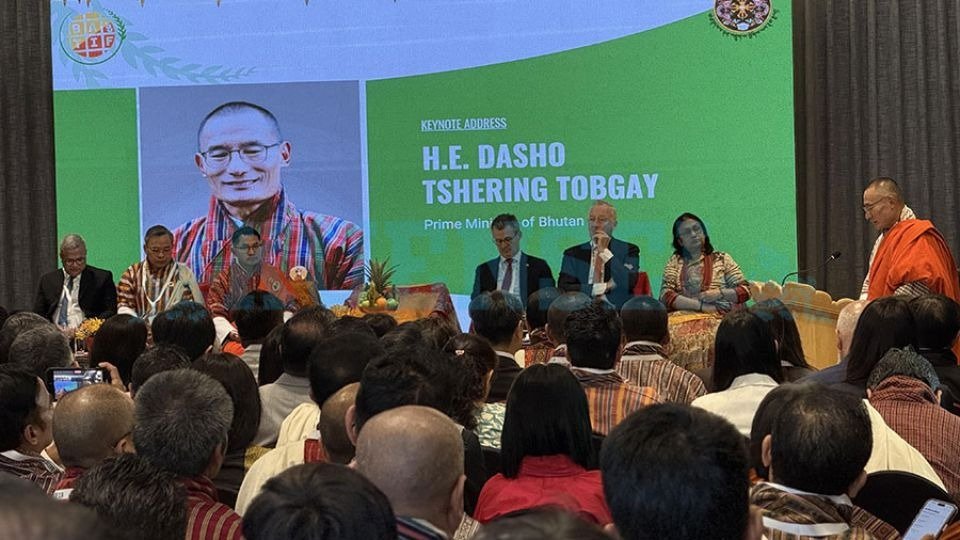
Bhutan and the EU marked more than four decades of diplomatic relations yesterday at a reception hosted by the Ambassador of the European Union to India and Bhutan, Hervé Delphin. The event was attended by Prime Minister Tshering Tobgay, cabinet ministers, diplomats, senior government officials, and development partners.
While Europe Day commemorates the 1950 Schuman Declaration that laid the foundation for the European Union, discussions in Thimphu focused strongly on the future direction of Bhutan-EU relations and growing European interest in Bhutan’s emerging economic sectors.
Ambassador Delphin said the partnership is entering a new phase centred on investment and economic collaboration.
“For over forty years, the bond between the European Union and Bhutan has been defined by shared values, deep mutual respect, and an enduring friendship,” he said. “As we look ahead, we are working hand in hand towards an investment-driven partnership model.”
The shift comes as Bhutan pursues economic transformation through initiatives such as the Gelephu Mindfulness City (GMC), agricultural modernisation, digital transition, renewable energy expansion, and sustainable tourism development.
According to the Ambassador, Bhutan is increasingly being recognised across Europe as a reliable and high-performing partner, particularly due to the successful implementation of EU-supported programmes and projects.
This growing interest was reflected during the Bhutan Investment Forum held earlier this year in Brussels, Frankfurt, and Prague, where Bhutanese agencies and businesses connected with European investors and companies involved in agriculture, renewable energy, information technology, and wellness industries.
European entrepreneurs reportedly expressed strong interest in Bhutan’s niche products and sustainable business opportunities.
Ambassador Delphin noted that discussions surrounding the Gelephu Mindfulness City are still at an early stage, with no direct investment negotiations yet underway.
“There are no direct investment discussions so far because the project itself is being developed in a very mindful and properly planned manner,” he said.
The EU is currently facilitating “match-making assistance” by linking interested European investors and entrepreneurs with Bhutanese initiatives. The Bhutan Investment Forum also featured a dedicated session on GMC to familiarise European businesses with the project’s long-term vision.
The Ambassador emphasised that human capital development would play a crucial role in the success of the GMC project.
“The GMC requires human capital development, and preparing human capital is one of the works of the EU in Bhutan,” he said.
Discussions between Bhutan and the EU are now increasingly focused on private investment, digital connectivity, green energy infrastructure, education, and information technology.
During his visit, Ambassador Delphin met Prime Minister Tshering Tobgay and cabinet ministers to discuss strengthening economic co-operation and creating concrete business-to-business investment opportunities.
The Ambassador is also expected to receive an audience with His Majesty The King.
EU officials are attending the Bhutan Agrifood Trade and Investment Forum (BATIF 2.0) today, with agriculture identified as another major area of collaboration.
According to Ambassador Delphin, the EU plans to support Bhutanese entrepreneurs in building stronger agricultural value chains and premium export-oriented products.
“It is not quantity people are looking for anymore,” he said. “Health-conscious consumers are now looking for better quality products.”
He added that Bhutan holds significant potential in niche and high-value agricultural products. EU support will focus on value addition, market-oriented production, disease-resistant crops, and private sector growth.
The Ambassador also highlighted the importance of Geographical Indication (GI) branding, which could help Bhutan position its agricultural products in premium international markets.
Over the years, the EU has supported Bhutan’s cash crop sector through investments in cold storage facilities, grading technologies, processing systems, and agricultural infrastructure.
Co-operation is expected to deepen further under the EU-Bhutan Multiannual Indicative Programme 2021–2027, valued at EUR 48 million.
The programme prioritises climate change and green growth, good governance, and digital transformation in education and public service delivery. Additional support has also been extended to sustainable tourism, parliamentary strengthening, civil society engagement, and private sector investment.
The EU-Bhutan partnership began in 1982 through collaboration in renewable natural resources before formal diplomatic relations were established in 1985.
Today, the relationship is evolving beyond development aid, with trade, investment, entrepreneurship, and skills development emerging as the new pillars of engagement.
Meanwhile, Bhutan is also hosting the European Union Film Festival for the first time. The three-day festival opens today at City Cinema in Thimphu and will feature six European films aimed at promoting cultural exchange and people-to-people engagement, especially among young Bhutanese audiences.
The festival will be inaugurated by Ambassador Hervé Delphin and Foreign Minister D. N. Dhungyel. All screenings are free and open to the public.