More than 30 European leaders, along with Canadian Prime Minister Justin Trudeau, have gathered in Yerevan, the capital of Armenia. This is a huge change in the geopolitical landscape of the South Caucasus. This week’s unprecedented dual summits mark a historic turning point for a country that has always been seen as Russia’s strongest ally in the region. In a move that signals a seismic shift in the geopolitical landscape of the South Caucasus, more than 30 European leaders, alongside Canadian Prime Minister Justin Trudeau, have converged on the Armenian capital of Yerevan. This week’s unprecedented dual summits mark a historic turning point for a nation traditionally viewed as Russia’s staunchest ally in the region.
The diplomatic marathon started on Monday with the European Political Community (EPC) summit. On Tuesday, there was a historic EU-Armenia summit. European Commission President Ursula von der Leyen and European Council President António Costa’s presence shows how committed the European Union is to a country that is still very much a part of Moscow’s economic and security structures, at least on paper.
For many years, Armenia’s survival depended on Russia. Armenia is a member of the Eurasian Economic Union (EAEU) and has a Russian military base. It has relied on Moscow for cheap energy. But in 2023, the “security architecture” that Armenia had faith in fell apart. When Azerbaijan launched a lightning military operation to take Nagorno-Karabakh, Russian peacekeepers stood by, and the Russia-led Collective Security Treaty Organization (CSTO) did not step in.
Sargis Khandanyan, chairman of Armenia’s foreign relations committee, said, “We knew that the security architecture we were in wasn’t working.” This disappointment has led to a rise in public and political support for the West. In March 2025, the Armenian parliament made history by passing a law that started the official process of joining the EU.
But this change comes with a lot of economic and diplomatic risks. Vladimir Putin, the president of Russia, has been quick to remind Armenian Prime Minister Nikol Pashinyan that Armenia depends on Russia, pointing out that European gas prices are much higher than the lower prices Russia offers. Putin has also said that being a member of both the EU and the EAEU is “impossible by definition.”
The stress is already showing in “hybrid” tactics. A few days before the summits, Russia stopped the import of Armenian mineral water. Many people saw this as a warning shot.
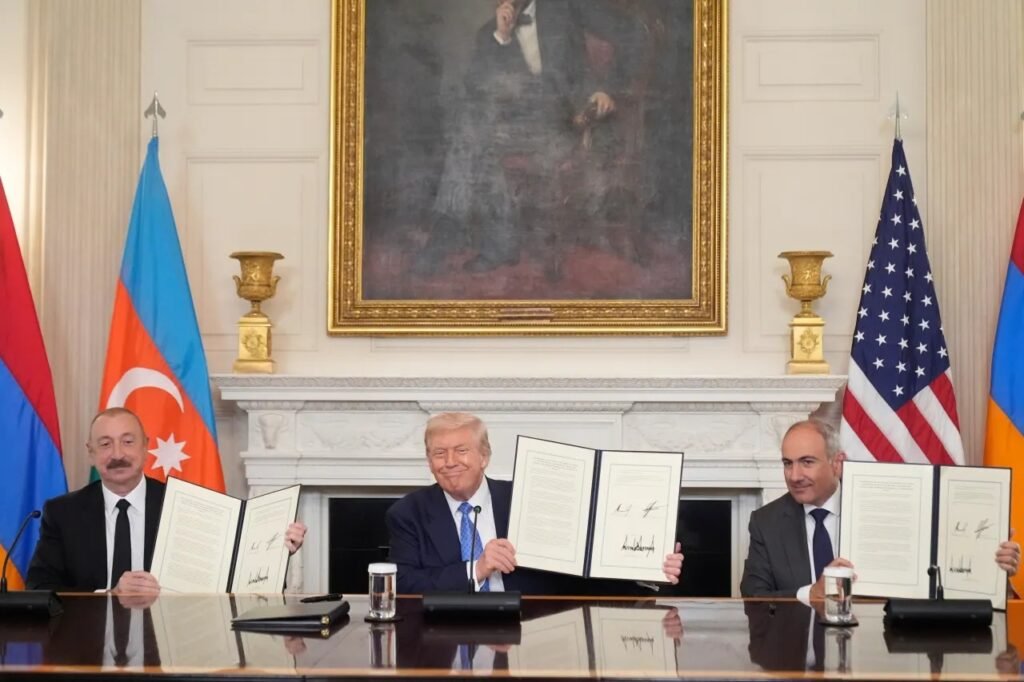
Even with the pressure, the push for Western integration keeps going. The “Trump Route for International Peace and Prosperity” is now possible thanks to a historic peace deal signed by Armenia and Azerbaijan at the White House last August. The goal of this connectivity corridor is to connect the area directly to European markets through Armenia’s border with Iran.
It’s clear what the European leaders walking through Yerevan mean: Armenia is no longer a quiet partner in Russia’s sphere of influence. It is a country that is actively looking for a new identity and a safer future in Europe, even though the shadow of its former protector is still very strong.