
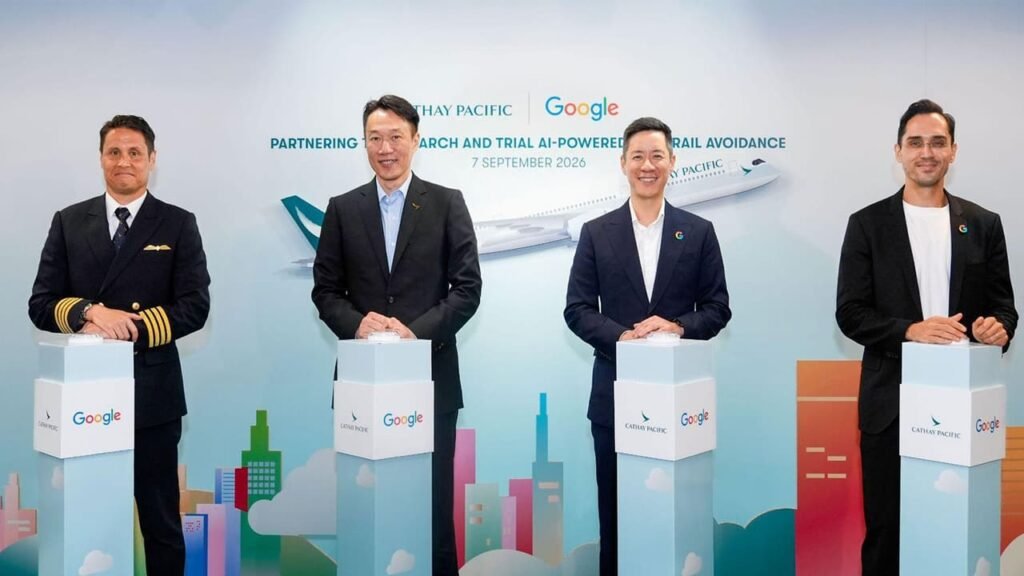
According to a joint statement released on Monday, Cathay Pacific and Google will expand the scope of a trial for an artificial intelligence-based system designed to reduce the climate impact of “contrails” (the white trails formed behind aircraft). Initial testing showed a 40% reduction in warming caused by contrails. An operational trial involving over 100 flights across Cathay Pacific’s network saw more than 80 flights adopt routes that avoided contrail formation. The companies stated, “Google estimates that warming from contrails on these flights was reduced by approximately 40%.” Following the initial trial, Cathay Pacific and Google are now launching a second, larger phase of flight trials across Asia and trans-Pacific networks to gather real-world operational data. While the initial trials yielded promising results across various flights, the companies noted that further research is needed to assess the implications of implementing contrail-avoidance measures across airlines and airspace. According to the statement, Cathay Pacific is Google’s first airline partner in the Asia-Pacific region to trial its AI-powered contrail-reduction technology and the first airline globally to test contrail avoidance on ultra-long-haul flights. Contrails, or condensation trails, are the white streaks that sometimes form behind aircraft flying at high altitudes in cold, humid conditions. While many trails dissipate quickly, some persist and evolve into larger clouds that can trap heat in the atmosphere. The statement cites previous research indicating that persistent contrails could account for approximately one-third of aviation’s total climate impact. Google’s contrail-reduction system utilizes AI-based predictive models, satellite imagery, and weather data to forecast areas where contrails are likely to form. Armed with this information, flight dispatchers and pilots can adjust altitudes to avoid these zones. Cathay Pacific incorporates these predictions into its ‘Electronic Flight Folder’ system, which provides pilots with real-time operational data alongside Google’s contrail forecasts. Lawrence Fong, Director of Digital and IT at Cathay, stated, “Aviation needs to transform to tackle climate change, and AI is accelerating progress in this direction.” He added, “This partnership brings together Cathay’s operational expertise and Google’s world-class AI capabilities to address the complex challenge of sustainability on a large scale.” Michael Yue, Managing Director and General Manager of Google Hong Kong, noted that the partnership is exploring how predictive AI can be applied to live operations to help “mitigate the climate impact of contrails using today’s aircraft and fuels.” The companies stated that the goal of these extensive trials is to generate a comprehensive operational dataset that enhances scientific understanding of contrail avoidance and helps improve industry practices in the future.