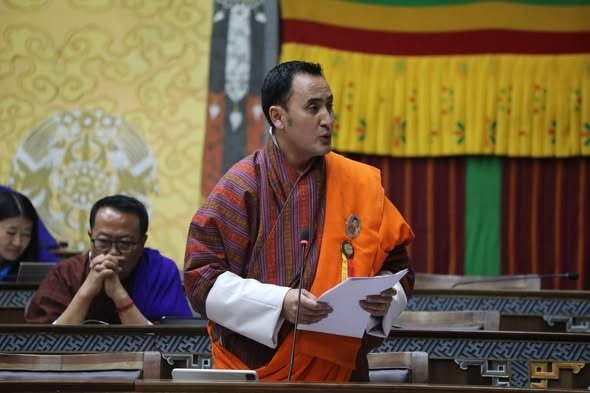
Members of Parliament in Bhutan have raised serious concerns over poor mobile and telecommunication connectivity in remote highland regions, saying communication problems continue to put lives at risk and isolate communities despite years of rural network expansion efforts. During discussions on the Action Taken Report presented by Namgay Dorji from the Ministry of Industry, Commerce and Employment, lawmakers highlighted how weak network coverage is affecting emergency services, travel safety and daily communication in remote parts of the country.
The minister informed the House that the government has made major progress through different phases of the Rural Connectivity Programme (RCP), which has expanded 2G and 4G services to more than 850 villages across all 20 dzongkhags. He said most rural areas have now been connected, although a few remote highland locations still remain outside coverage due to difficult terrain and high infrastructure costs compared to the small number of households living there.
According to the minister, the supplementary phase of RCP 7, launched on May 6, 2025, aims to connect 17 villages in 12 gewogs covering around 255 households across seven dzongkhags. He also said the ministry, together with the Bhutan InfoComm and Media Authority, has started technical assessments across the country to identify weak network areas and evaluate signal strength, internet speed and service reliability. Surveys have already been completed in Lhuentse, Samtse, Samdrup Jongkhar, Trashiyangtse and Mongar.
Despite the government’s efforts, several MPs said people in remote areas continue to face major hardships because of unreliable communication networks. Kuenga said emergency communication remains a serious concern during the cordyceps harvesting season when many highlanders travel to isolated mountain areas. He said some people are forced to walk for nearly two days to find network coverage during emergencies and suggested providing satellite phones in groups as a temporary solution.
Lamdra Wangdi also raised concerns about travellers going to southern and eastern dzongkhags through India. He said travellers often remain completely cut off because Bhutanese SIM cards do not work there and they cannot easily access Indian SIM cards. According to him, some travellers have reportedly been stranded for several days without any means of communication during emergencies.
Meanwhile, Kuenzang Thinley said poor connectivity is affecting emergency medical evacuations and delaying critical healthcare services in remote areas. He urged the government to clarify whether providing satellite phones to remote communities could realistically be implemented.
Responding to the concerns, Minister Namgay Dorji explained that the use and import of satellite phones are strictly regulated by BICMA. He said only government offices and authorised organisations are allowed to use satellite phones for purposes such as disaster management, security and medical emergencies, meaning they cannot be distributed widely among the public.
Some MPs proposed alternative communication methods such as walkie-talkies and handheld radios for temporary use in remote areas. Sonam Tashi said communities should also consider practical local solutions, especially since cordyceps collectors stay in highland areas only seasonally. He noted that BICMA already permits the use of walkie-talkies within limited distances.
Members also questioned the affordability of mobile phones and the high cost of mobile data services. In response, the minister said phone prices are determined by market conditions and not directly regulated by the government, although authorities continue monitoring the market to ensure fair competition and consumer protection.
Following the discussion, Parliament directed the Good Governance Committee to further examine the concerns raised by MPs and submit additional recommendations during the next parliamentary session. Several lawmakers stressed that improving connectivity in Bhutan’s remote regions will require more than simply expanding network coverage and called for stronger focus on reliable service, emergency communication systems and practical solutions for isolated communities.