In the eastern Bhutanese town of Trashigang, life moves gently to the rhythm of fluttering prayer flags and mountain winds. It is a place where, according to Ngawang Gyeltshen, “smiles come easily” and strangers are welcomed with tea before questions are asked.
Today, Gyeltshen lives in Thimphu with his spouse and one-year-old daughter, balancing family life with a growing mission to bring clean energy solutions to Bhutan’s most remote communities.
For the past six years, the solar engineer has worked at the forefront of Bhutan’s renewable energy movement, helping install solar thermal heating and photovoltaic systems across the country. But his journey into solar energy began in some of Bhutan’s harshest and most isolated regions.
One of his earliest projects involved installing a solar water heating system at a rural nunnery, where women previously relied on burning firewood simply to access hot water. Another formative experience came at a remote school situated 4,500 metres above sea level, where students depended on burning yak dung for light and warmth.
“In places far beyond the grid’s reach, solar power was transformational,” Gyeltshen recalled. “I saw first-hand how solar could change lives. That experience inspired me to dedicate my career to solar development and sustainability.”
Since then, Gyeltshen has contributed to more than 46 solar projects throughout Bhutan, bringing electricity, heating, and energy security to communities, schools, offices, and conservation facilities.
Among his notable projects was helping World Wide Fund for Nature (WWF) solarize office spaces, a remote ranger station, and a vocational school training site under the Energizing Communities and Conservation (ECCo) programme.
For Gyeltshen, however, the most rewarding aspect of the work remains the direct human impact.
“By embracing the sun, Bhutan can build a cleaner, stronger and more self-reliant future — one where light never fades, even in the heart of winter,” he said.
A Leap Across Continents
In 2025, Gyeltshen received what he describes as a once-in-a-lifetime opportunity: a fully funded internship in Switzerland with Hassler Energia, a company with four decades of experience in solar innovation.
Supported by Hassler Energia and WWF’s ECCo programme, the internship aimed to strengthen Bhutanese expertise in solar technologies and sustainable energy systems.
The timing was deeply personal. Only weeks after the birth of his daughter, Gyeltshen left Bhutan’s Himalayan peaks behind for the alpine slopes of Graubünden, Switzerland, where he spent two months immersed in advanced solar engineering practices.
“Every panel we install is a small step toward a greener and more equitable Bhutan,” he said. “The future of Bhutan’s development lies in combining our traditional values of harmony with nature and modern clean technologies like solar.”
The exchange exposed him to new approaches in system efficiency, maintenance standards, safety culture, and quality assurance processes — lessons he has already begun implementing back home.
“I’ve started organizing small teams to share and implement what I learned about Swiss precision, safety culture, and system monitoring tools,” he explained.
The internship also challenged long-held assumptions about solar applications in Bhutan. For example, many Bhutanese engineers believed solar systems could not be installed on tile roofs until Gyeltshen witnessed such systems operating successfully in Switzerland.
Lighting Rural Bhutan
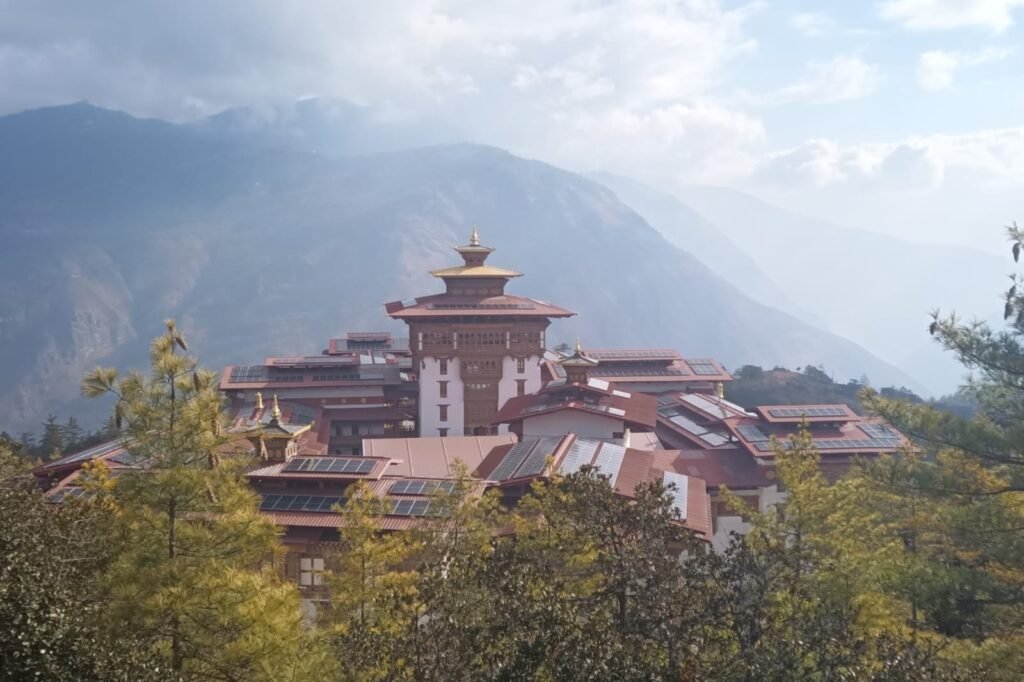
As Bhutan expands its renewable energy ambitions, solar power is increasingly seen as critical to the country’s future — especially for rural communities beyond the national grid.
For generations, many remote households depended heavily on firewood, kerosene lamps, and candles. Solar energy is now helping reduce pressure on forests, lower carbon emissions, and improve educational opportunities.
“Students in rural areas study at ease without having to use kerosene lamps and candles,” Gyeltshen reflected.
Bhutan has set an ambitious target of generating 5,000 megawatts of solar power by 2040, complementing its hydropower resources.
“Our mountains gift us the power of rivers, yet many of our remote communities still live beyond the reach of the grid,” Gyeltshen said. “And in winter, when some hydropower plants slow or shut down, the nation feels the quiet strain of reduced energy. In those moments, the sun becomes our steadfast ally.”
The internship programme that supported Gyeltshen is expected to continue expanding. This summer, two additional Bhutanese engineers will travel to Switzerland under the ECCo initiative, while on-the-ground solar training programmes continue in Bhutan, Cambodia, Madagascar, and the Central African Republic.
For Gyeltshen, the work remains deeply personal — a commitment not only to clean energy, but to the future of his homeland.
Each sunrise over Bhutan’s mountains, he says, brings the country one step closer to a brighter and more resilient future.
“One panel at a time,” he said, “the work goes on.”