
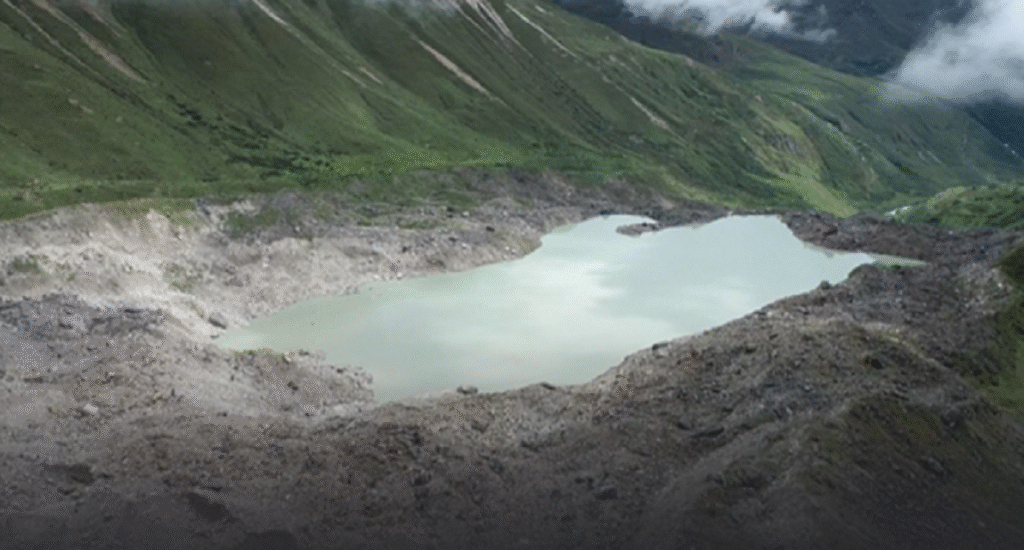
The flood in Paro in August was initially thought to have been caused by a breach of Jechu Drake Lake. However, a detailed assessment by the National Centre for Hydrology and Meteorology, or NCHM, has found that the flood was triggered by a smaller glacial lake upstream. The assessment has also highlighted the need to strengthen early warning systems and better understand the stability of glacial lakes across the country.
When sudden flooding hit the Pachhu valley on 9th August and damaged two bridges along the Soe-Lingzhi mule track, many wondered if Jechu Drake Lake had burst.
However, a technical team from NCHM found that the water did not come from a breach of the main Jechu Drake Lake. Instead, the likely source was a smaller, unnamed glacial lake about two kilometres upstream.
The water from this smaller lake flowed towards Jechu Drake Lake before continuing downstream.
“The flood incident on ninth August was not caused by a breach of the main Jechu Drake Lake,” said Tandin Wangchuk, the Deputy Chief Hydromet Officer for NCHM. “The lake acted as a temporary storage and transmission basin, where the outflow from the lake upstream was conveyed to the downstream channel.”
“The failure of the lateral moraine resulted in water flowing out of the lake. The water was transmitted to the main Jechu Drake Lake through numerous subsurface englacial drainage systems. This caused the water level in the main lake to rise by approximately thirty centimetres, and the increased water level was then propagated downstream through the existing outlets into the main channel,” added Tandin Wangchuk.
According to the locals and trekkers on the site, the flood started at around 11 AM.
The flood took about 12 hours to reach the water-level station at Bongdey, more than 60 kilometres downstream.
While this travel time could give downstream communities valuable time to prepare, NCHM says monitoring closer to the source and strengthening the early warning system are important.
“We have already established an early warning system for Phachhu and Wangchhu. Under this system, we have an automatic water-level station installed at Gunitsawa in Paro,” said Trashi Namgyal, the Chief Engineer with NCHM.
“We need to strengthen this system. As a temporary measure, we have also identified staff who can relay information from the site to our control room and to communities downstream.”
NCHM recommends coordinating community-level GLOF awareness and establishing a warning and response protocol for settlements along the Pachhu valley.
The assessment found no significant failure of the main moraine dam during the August flood. However, the centre also recommends conducting a geophysical survey to determine what the dam is made of and how stable it is.
For communities downstream, the key message is to stay alert and act quickly when a warning is issued. There may be time to prepare in some floods, but sudden flooding can happen with little or no warning.