
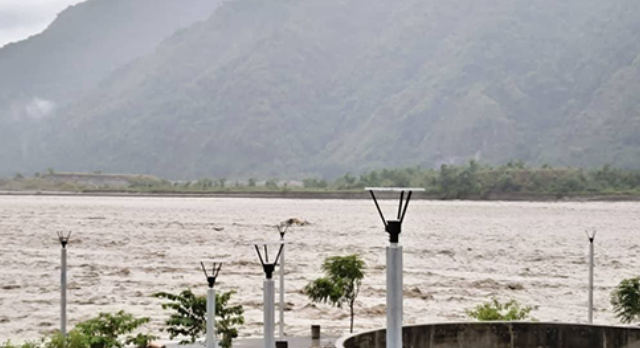
Agency: The flood that struck several parts of Bhutan on 5th October destroyed homes, washed away bridges, and disrupted infrastructure, leaving many residents in shock and confusion. In the days that followed, questions emerged over whether early warnings were communicated to the public before the disaster unfolded.
The National Centre for Hydrology and Meteorology (NCHM), issued a formal “Flood Remarks” bulletin at 10:30 AM on 5th October 2025 when flooding was well under way. The flood was such a surprise that several excavators and vehicles were washed away in Amochu river.
The NCHM bulletin warned of extremely heavy rainfall across southern Bhutan and it stated that heavy rain had been observed since 1st October in many areas, including Samtse with 302 mm, Phuentsholing with 285 mm, Paro with 72 mm, Haa with 83.8 mm, and Thimphu with 57 mm in the previous 24 hours. The update cautioned that “owing to the continuous rainfall, water levels across the country have increased” and advised the public to “take necessary precautions.”
Critics say such a notification should have been sent the day before or even a few days before and be amplified by the relevant agencies.
NCHM officials said that light to moderate rain forecasts had already been issued through social media platforms since 1st October, warning of possible heavy rainfall conditions. However, the flood occurred later the same day the formal “Flood Remarks” was released, raising concerns about whether the information reached communities on time or whether people were adequately aware of the potential risk.
Officials from NCHM clarified that while they were monitoring weather conditions and issuing rainfall forecasts, it is still difficult to predict specific flood events due to technical limitations. “We can forecast rainfall intensity, but not whether it will trigger a flood,” an NCHM official said. “We do not yet have the right instruments to detect floods in real time,” the official added.
The Department Local Governance and Disaster Management confirmed receiving NCHM’s forecast prior to the flood and said relevant agencies had been informed to remain cautious.
However, many residents in the affected areas reported that they had not received any direct alert or public notice before the disaster. The sudden surge of water left people with little time to react, forcing emergency responses across multiple dzongkhags.
While NCHM did issue warnings within its capacity, the incident highlights a gap between forecast communication and public awareness. Bhutan’s mountainous terrain, rapid river systems, and lack of real-time hydrological monitoring equipment make early flood detection difficult.
The 5th October flood has brought renewed attention to the need for stronger coordination among agencies and improved systems for delivering warnings directly to the public. NCHM has stated that it continues to upgrade its equipment and communication channels to provide more precise and timely warnings in future weather emergencies.