
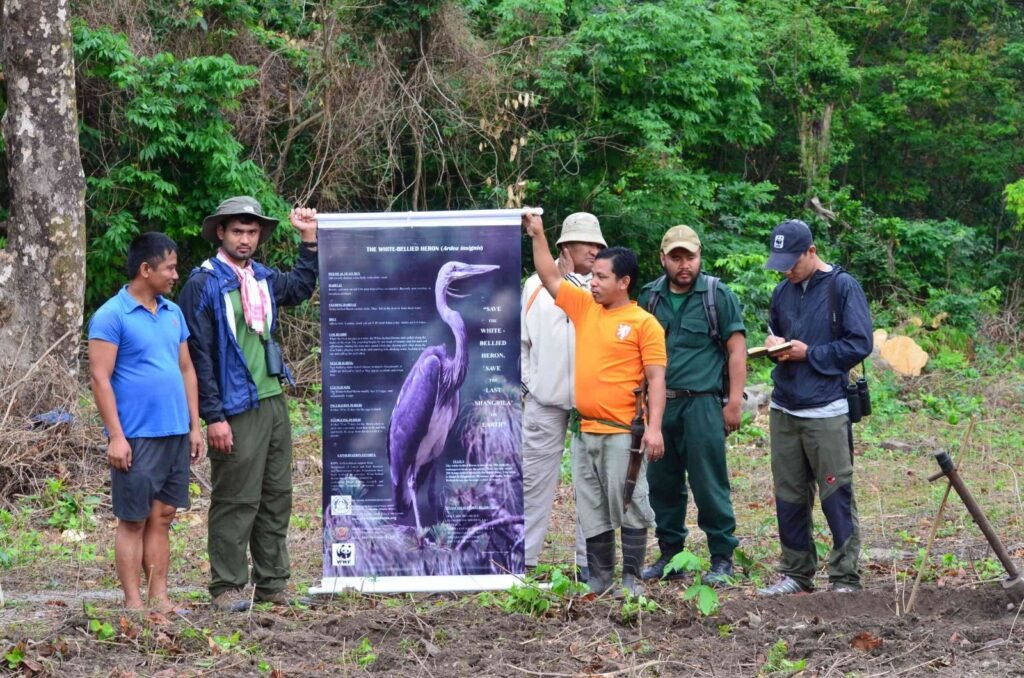
In a major victory for global biodiversity, the Kingdom of Bhutan has officially become the primary stronghold for one of the rarest birds on Earth. At the 2026 White-bellied Heron International Conference held in Thimphu, conservationists announced that Bhutan’s population of the critically endangered species has reached a record-breaking 31 individuals. With the global population estimated at only sixty, this small Himalayan nation now serves as the guardian for half of the entire species. The Royal Society for Protection of Nature (RSPN) made the announcement, marking a monumental achievement in a decade-long struggle against extinction. The current count of 31 birds surpasses the previous record of 30 set back in 2003. According to the 2026 Annual Population Survey, the census includes 26 birds thriving in the wild—primarily within the Punatsangchhu and Mangdechhu basins—and five individuals being carefully raised at the specialized Conservation Breeding Center.
Researchers emphasize that although the increase of two birds over the last year may appear modest, each individual represents a crucial lifeline for a species on the verge of extinction. This success is the result of a rigorous five-year project supported by Germany’s International Climate Initiative, which has allowed Bhutan to pioneer a dual approach of strict habitat protection and controlled captive breeding.
However, the conference also highlighted the shifting nature of the threats these birds face. As Bhutan modernizes, the herons—particularly young hatchlings—are struggling to navigate man-made structures. Experts identified power transmission lines as a primary hazard, noting that collisions are a leading cause of mortality for birds unfamiliar with industrial infrastructure.
To mitigate these risks, the RSPN is working in close coordination with the Department of Energy and the Bhutan Power Corporation. Strategies include the installation of specialized “fly diverters” on high-voltage lines to increase visibility for the birds. Research Officer Tshering Tobgay noted that ongoing consultations with government stakeholders remain vital to ensuring that Bhutan’s economic development does not come at the cost of its natural heritage.
The conference, returning to Thimphu after a ten-year hiatus, brought together experts from ten countries, including India, Singapore, China, and Australia. The international presence points out the importance of Bhutan’s conservation model, which blends community-led stewardship with high-tech threat mitigation.
As the conference concludes, the message from Thimphu is clear: Bhutan has carved out a sanctuary of hope. While the white-bellied heron remains critically endangered, the kingdom’s record-breaking numbers provide a rare and inspiring blueprint for how dedicated conservation can turn the tide for a species once thought to be lost.