
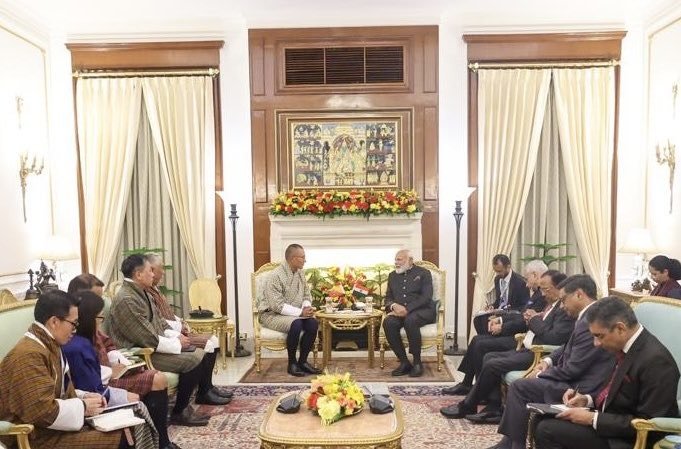
While global powers focus on “Silicon Peace” and semiconductor supremacy, Bhutanese Prime Minister Tshering Tobgay has issued a stirring reminder that the true measure of technological success should be the well-being of the people.
Speaking on the sidelines of the Global AI Impact Summit 2026 in New Delhi, Tobgay warned that the development of artificial intelligence must not be allowed to run “unbridled,” calling for a transition from high-level rhetoric to actual implementation of safety standards.
For Bhutan, a nation of 800,000 that famously prioritizes Gross National Happiness (GNH) over GDP, the AI revolution presents a unique philosophical challenge. Tobgay emphasized that AI must be a tool that serves the values of GNH—psychological well-being, ecological resilience, and cultural preservation—rather than a force that erodes them.
“Gross national happiness is a development philosophy gifted by enlightened kings. AI is a tool, and used properly, it can enhance the implementation of these values.” The Prime Minister expressed concern that while the global community talks extensively about transparency and regulation, the actual implementation of these guardrails is lagging. He noted that without responsible oversight, AI risks becoming a “rogue force” that could be misused for destruction rather than progress. Acknowledging anxieties about AI reshaping job markets and the need for nations to be “prepared” for the shift. the risk of AI systems ignoring the spiritual and cultural nuances of smaller Himalayan nations. Ensuring AI supports Bhutan’s status as a carbon-negative “biodiversity hotspot” by aiding in climate action and governance.
Despite his warnings, Tobgay remains an “optimistic skeptic.” He believes that if the “floodgates” are managed correctly, AI offers unforeseen opportunities for livelihood and work. Bhutan’s strategy involves a careful examination of digital transformation policies to ensure they strengthen—rather than weaken—the environment and the form of governance. Tobgay’s remarks aligned closely with the summit’s host, Prime Minister Narendra Modi, who introduced the M.A.N.A.V. Vision (Moral, Accountable, National, Accessible, Valid). Both leaders agreed that while AI should be given an “open sky” for innovation, the ultimate command must remain firmly in human hands.