
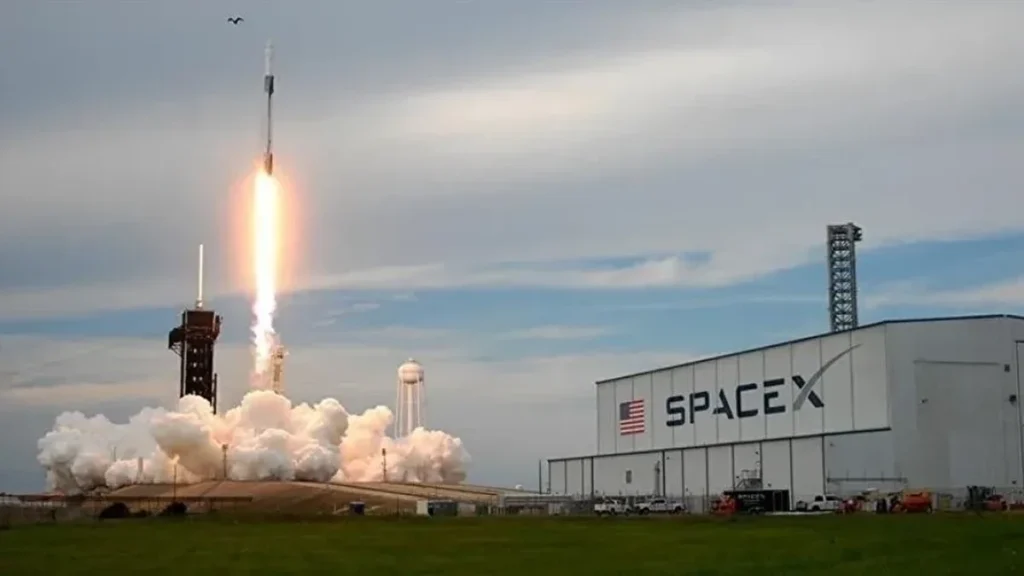
American aerospace company SpaceX set a new company record on Saturday night by launching two Falcon 9 rockets from separate coasts within a span of just 38.5 minutes. This is being hailed as a major operational milestone for SpaceX. Previously, the company’s record for the shortest interval between two orbital mission launches was 65 minutes, set in August 2024. The first mission lifted off at 9:12 PM EDT from the Cape Canaveral Space Force Station in Florida. The Falcon 9 rocket carried eight Low Earth Orbit (LEO) satellites for the satellite communications company Globalstar. Approximately 56 minutes after launch, these satellites were successfully deployed into their orbits over a period of about six minutes. These satellites will help strengthen Globalstar’s existing network and communication infrastructure. Just 38.5 minutes after the first launch, at 9:50 PM EDT, a second Falcon 9 lifted off from the Vandenberg Space Force Base in California. This mission carried the classified USSF-366 payload for the US Space Force. Due to the classified nature of the mission, detailed information regarding the payload has not been made public. A notable achievement of both missions was the successful landing of the Falcon 9 first-stage boosters. SpaceX’s reusable rocket technology once again demonstrated the company’s rapid launch capabilities. Booster B1090, used for the Globalstar mission, successfully landed vertically at Cape Canaveral’s Landing Zone 40 about eight minutes after liftoff, marking the completion of its 14th mission. Meanwhile, booster B1088 from the USSF-366 mission landed on the drone ship “Of Course I Still Love You” in the Pacific Ocean after completing its 18th flight. With this landing, the total number of successful landings by SpaceX Falcon boosters reached 650. Globalstar’s satellite launch is considered significant for the company. The mission was originally scheduled for May but was postponed due to reasons related to satellite readiness. A successful deployment is expected to strengthen network continuity for Globalstar’s direct-to-device communication services. Globalstar’s chief, Paul E. Jacobs, described the successful satellite deployment as a crucial step for the company, noting that it would bolster the essential infrastructure for consumer and business communication services worldwide.