
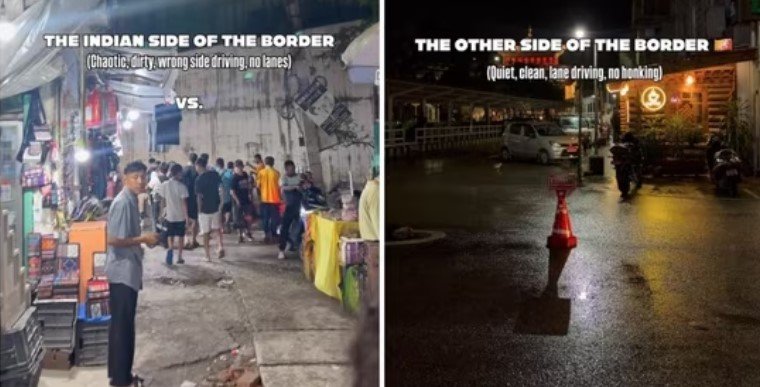
A viral social media travelogue chronicling a couple’s journey across the Indo-Bhutan border has sparked intense online discussion regarding civic management and environmental stewardship. Documenting their transition from Jaigaon in India’s West Bengal directly into the neighboring Bhutanese town of Phuentsholing, the travelers highlighted a stark visual contrast in infrastructure, cleanliness, and public order. The observations, framed around the provocative question of whether domestic civic challenges have become too deeply entrenched to resolve, quickly resonated with thousands of netizens reflecting on the current state of public amenities and civic discipline in the region.
The couple’s footage contrasted the hectic, unregulated traffic, overflowing municipal waste, and ongoing construction delays on the Indian side with the meticulously organized, litter-free streets and tranquil, eco-conscious urban planning immediately across the Bhutanese gate. While some commenters echoed the couple’s frustration, labeling the visible disparity a systemic failure of local administrative accountability, others defended the complex socio-economic realities of the region. Many noted that managing a highly dense, commercially vibrant transit hub like Jaigaon presents vastly different logistical challenges than maintaining a highly regulated, low-population tourist entry point. Despite the debate, the viral comparison has drawn renewed attention to the urgent need for robust waste management frameworks, stricter traffic enforcement, and sustained public-private cooperation to uplift border infrastructure.