
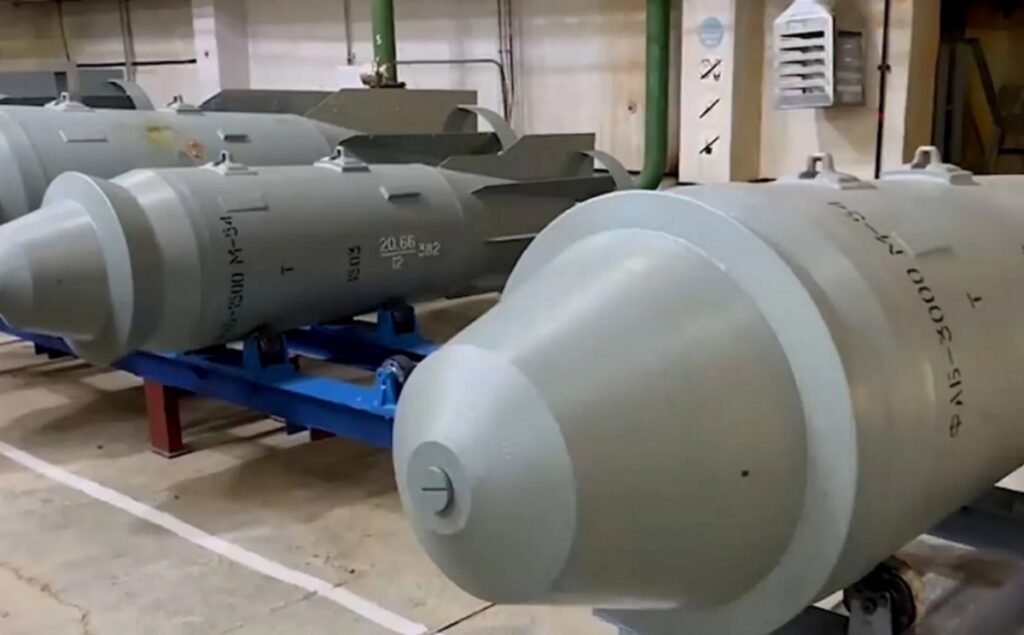
Following the release of films allegedly depicting the large bomb being used on Ukrainian forces, Russia has once again brought attention to the FAB-3000, one of the most devastating weapons in its conventional arsenal. President Vladimir Putin has promised more potent attacks in retribution for recent Ukrainian operations, which coincides with the strike.
The FAB-3000 is built for pure devastation, in contrast to missiles intended for precise strikes. It was first created in the Soviet era and has since been modified into a glide bomb that can destroy broad areas from a comparatively safe distance. This is the reason the weapon is so important.
The FAB-3000 is a high-explosive airborne bomb weighing 3,000 kilograms (6,600 pounds). ‘Fugasnaya Aviatsionnaya Bomba’, which translates to ‘High-Explosive Aviation Bomb’ in Russian, is where its name originates, and ‘3000’ indicates its approximate weight. Explosives make up between 1.2 and 1.4 tonnes of that weight, with the remaining portion consisting of its thick steel casing and other parts. The bomb was first created during the Soviet era with the intention of destroying military installations, industrial facilities, heavily fortified targets, and troop concentrations.
One of the biggest conventional bombs Russia is known to have used in the conflict in Ukraine is the FAB-3000. It can flatten reinforced buildings, destroy bunkers and subterranean positions, collapse defensive fortifications and trenches, create enormous craters, and damage buildings hundreds of meters away from the site of impact.
According to military analysts, availability and cost are the key factors. FAB bombs are far less expensive to produce than ballistic and cruise missiles. Without creating completely new missiles, Russia can convert substantial Cold War-era stocks into somewhat accurate stand-off weapons by adding UMPK guidance kits.Moscow has been able to sustain attacks while preserving its more advanced missile stock because to this tactic.
The FAB-3000’s increased use is indicative of a larger change in Russian strategy. Moscow is increasingly using huge glide bombs to overwhelm Ukrainian military positions and infrastructure from outside the reach of many air-defense systems instead of relying solely on costly precision missiles. Military analysts claim that glide bombs like the FAB-3000 have become one of Russia’s most challenging battlefield weapons to neutralise because the bombs themselves are difficult to intercept once released and the launching aircraft frequently remain well behind the front lines, despite Ukraine’s repeated calls for more sophisticated Western air defence systems to counter these attacks.