
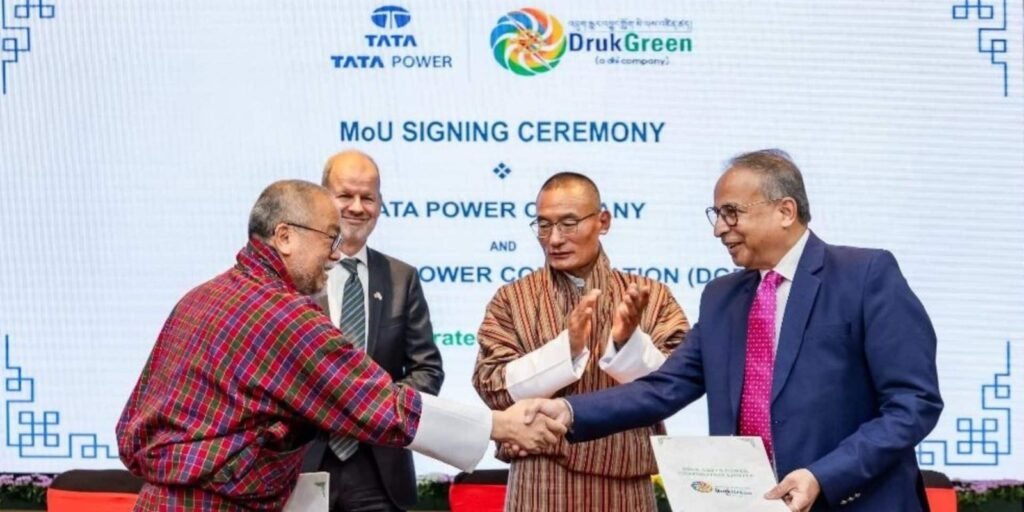
Tata Power and Druk Green Power Corporation (DGPC) have signed a Memorandum of Understanding (MoU) aimed at building a skilled workforce ecosystem to support their ongoing partnership to jointly develop 5,000 MW of clean energy capacity in Bhutan. The agreement was signed in the presence of Bhutan Prime Minister Tshering Tobgay by Tata Power CEO and Managing Director Praveer Sinha and DGPC Managing Director Chhewang Rinzin.
Under the partnership, training programmes will be delivered through the Tata Power Skill Development Institute (TPSDI), which will provide training infrastructure, technical expertise, accreditation support, and specialised course materials. DGPC will coordinate with Bhutanese authorities to mobilise trainees and implement the programmes across the country.
According to Tata Power, the initiative is designed to strengthen Bhutan’s clean energy workforce by training professionals in safe operations, operations and maintenance, and emerging energy technologies. Praveer Sinha said the collaboration aims to create a long-term talent ecosystem capable of supporting Bhutan’s growing renewable energy sector.
The training programme will be implemented in multiple phases. The first phase will focus on safety training and induction programmes for workers before entering project sites. The second phase will provide construction-related training, including material handling and earth-moving equipment operations. The third phase will focus on specialised technical training for the long-term operation and maintenance of clean energy assets.
Chhewang Rinzin said the initiative would help build the local capabilities required for the ambitious 5,000 MW clean energy partnership and support Bhutan’s national workforce priorities. DGPC will work closely with Bhutanese authorities to identify skill requirements and secure necessary approvals, while Tata Power will coordinate approvals from the Government of India.
TPSDI was established to address skill gaps in the power sector through modular training and certification programmes. The institute is accredited by the National Safety Council of India and is also an approved training partner of the National Skill Development Corporation. It currently operates training centres across India covering thermal, hydel, solar, wind, renewable energy, and green hydrogen technologies.
Tata Power stated that its total operational and pipeline energy capacity now exceeds 26 GW, including approximately 17.5 GW of clean energy projects and around 8.9 GW of thermal generation capacity. The company also operates over 7,400 circuit kilometres of transmission lines and serves nearly 1.3 crore customers through its power distribution businesses. In addition, Tata Power has established 4.9 GW of integrated solar cell and module manufacturing capacity, signed 2.8 GW of pumped hydro storage projects, and expanded its electric vehicle charging network to more than 7,000 public charging points across 706 cities and towns in India.