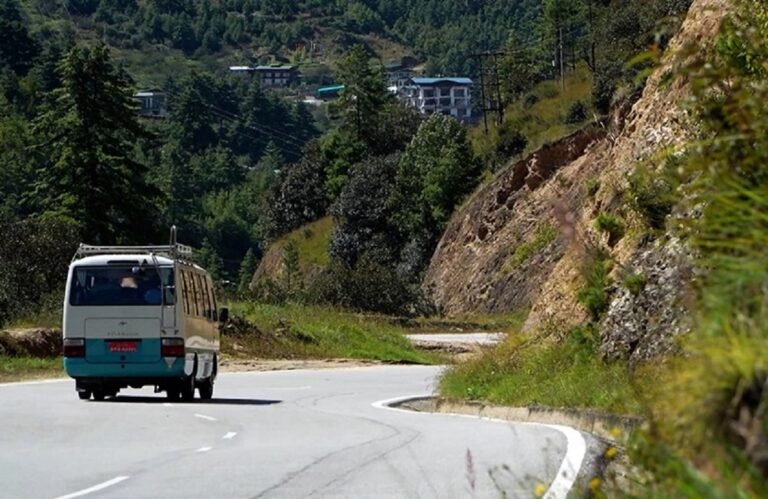
When dawn clocks in at Thimphu, people from all walks of life awake to prepare for the day in the bustling city. The cool weather complimented by the lush greenery in the city freshens up the air, leading to people kickstarting their day with a refreshing feeling. As a carbon-negative country, this easily makes Bhutan as one of the top countries with the cleanest air in the world.
However, with mounting numbers on vehicle ownership, bukhari use, waste burning and transboundary emissions from neighbouring countries, this cherished clean breathable air is now slowly deteriorating as the years pass by, raising questions over air quality and its associated risks on health.
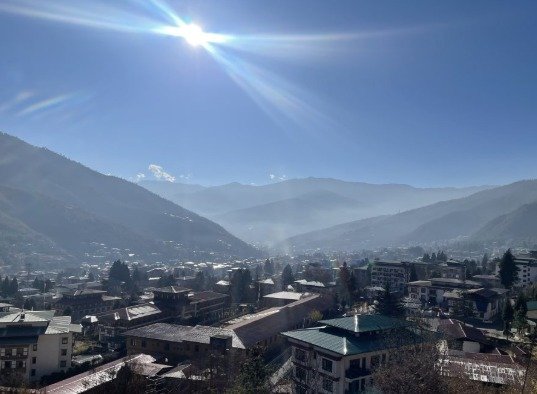
Taking a fresh morning walk towards the Buddha Point right after sunrise, one can take a glimpse of the majestic Thimphu valley. Having a closer look, the valley is clouded with greyish haze entrapped due to an environmental effect caused by the cold winter air.
Statistics from AccuWeather and IQAir show increasing pollutant levels in Thimphu. Particularly during morning hours between morning 8 am-11 am and evening 5 pm-11 pm, where the Air Quality Index (AQI) falls within the 50-100 range. This indicates moderate air quality risks where it is generally acceptable but sensitive people may feel some effects from exposure.
Especially during peak rush hours, the data also reveals significant spikes in AQI levels (over 100-105), crossing the moderate risk ceiling momentarily.
AccuWeather categorizes this range as the ‘Unhealthy’ category where “Health effects can immediately be felt by sensitive and healthy people. Prolonged exposure may result in health complications such as having difficulty in breathing and throat irritation.”
This means residents of Thimphu, including pedestrians, civil servants and students were breathing the contaminated air that is worsening over time with increasing vehicular emissions, rapid urbanization, and uncontrollable transboundary emissions.
A study titled “Spatiotemporal patterns of asthma in Bhutan: a Bayesian analysis” by Tsheten, T et al, provides an in-depth analysis on asthma and its connection to environmental factors in Bhutan. The study reveals significant scientific insights on how particulate matter (PM) is correlated with the exacerbation of asthma.
Particulate matter is a type of pollutant concentration that originates from smoke from burning wood and gaseous emissions from industries and automobiles. Tiny particles can penetrate the deeper part of the lungs, harming airways and increasing risks of asthma and asthma exacerbation. This implicates a growing concern over respiratory health of residents in Thimphu over the longer term.
Another study titled “Transboundary sources dominated PM2.5 in Thimphu” (by Sharma S, Sharma R, Sahu SK, et al) from recent years (2018-2020) reported by The Bhutanese earlier provides data on transboundary emissions originating from neighbouring countries. Transboundary emissions contribute PM2.5 concentrations in Thimphu and are mainly from India (44%), Bangladesh (19%), and China (16%). This means Thimphu receives over 80% of emissions from beyond its borders, at uncontrollable scales.
Strategies employed by the Government. The National Clean Air Action Plan (NCAAP)
Launched on 15th September 2025 by the Department of Environment and Climate Change in collaboration with the International Centre for Integrated Mountain Development (ICIMOD), the NCAAP aims to tackle the growing air quality concerns in Bhutan by improving monitoring frameworks and developing data-driven strategies.
The initiative aims to provide evidence-based strategies in combating air quality challenges, strengthening existing institutional frameworks and improving effective monitoring and coordination across sectors. It is an imperative course of action in preventing future problems and refining strategies to implement effective solutions.
During the Meet the Press session, the Ministry of Energy and Natural Resources explained that the development of the Action plan is currently underway. In collaboration with ICIMOD, the ministry explained that the Action Plan is being developed closely in line with national development priorities. Furthermore, the Action Plan aims to develop better monitoring and evaluation frameworks to track progress in identified sectors.